
The Science Behind Resin
What the Founders of Our Hobby Already Proved
For more than four decades, the legendary founders of the model-horse hobby demonstrated through both experience and results which casting materials truly stand the test of time. While sculpting and artistry naturally draw the most attention, the long-term performance of any model depends just as much on the chemistry of the resin itself.
Behind the scenes, two very different polymer systems dominate casting: polyurethane and polyester composites. Their behavior at the chemical, mechanical, and structural level determines everything from crispness of detail to stability over decades.
The Gold Standard: American-Made Polyurethane Resin
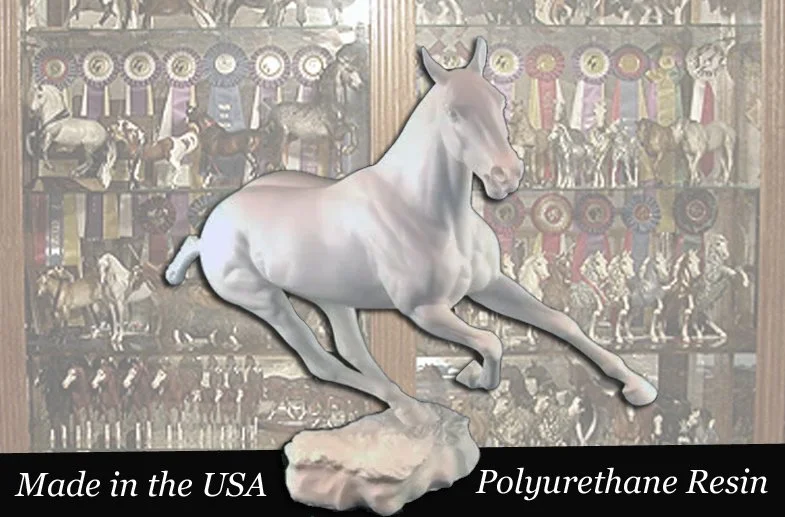
The resin that built the model-horse hobby from the 1980s onward has always been polyurethane manufactured in the United States. Every major supplier used by professional casters and studios such as Smooth-On, Alumilite, Polytek, BJB Enterprises, and specialized industrial producers manufactures polyurethane systems that are purpose designed for fine-art miniature casting.
These are the exact materials that defined the quality collectors still expect today.
Polyurethane forms a controlled crosslink density during cure that produces a uniform microstructure optimized for:
extremely fine detail reproduction
stable and predictable shrinkage below one percent
strong but not brittle finished parts
smooth sanding and finishing behavior
long-term dimensional stability
In other words, polyurethane resin exists because artists needed a high-performance material capable of capturing the smallest surface details without cracking, warping, or aging poorly.
This is why, in the model-horse world, the word “resin” has always meant polyurethane. It is the universally understood casting standard.
Why Polyester Composites Are Different
Polyester “resin” is an entirely different category both chemically and structurally. Unsaturated polyester polymers are more brittle, less dimensionally stable, and prone to significantly higher volumetric shrinkage during cure. Typical polyester shrinkage ranges from four to ten percent compared to less than one percent for polyurethane. Because the base polyester network lacks toughness, manufacturers rely on very heavy filler loading to compensate.
Common fillers include:
marble dust
stone powder
talc
wood flour
microspheres
These additives bulk up the volume, reduce cracking, and create a material that is heavy and stone-like. This is ideal for architectural reproductions, large decorative statuary, garden pieces, and souvenir figurines. It is not suited for precise miniature work.
A “charged polyester” simply refers to polyester resin that has been heavily loaded with filler. This is standard practice for architectural composites and faux-stone decorative items rather than fine-art castings.
Quick Comparison
Polyurethane Resin (Model-Horse Standard)
purpose made for fine miniature casting
captures crisp detail
extremely low shrinkage
stable and long lasting
strong without brittleness
sands and finishes predictably
the established standard in the model-horse hobby
Polyester Composite (Decorative Casting Material)
inexpensive bulk-plastic composite
heavy and brittle
much higher shrinkage
strong odor during cure
depends on fillers such as wood powder, marble dust, or talc
used for large decorative objects rather than fine miniatures
In the casting and model-horse world, the term “resin” specifically refers to polyurethane. Polyester composites belong to a different category entirely.
Why This Matters to Collectors
Understanding the difference between polyurethane and polyester composites allows collectors to:
assess long-term durability
protect financial value
recognize genuine fine-art castings
identify nonstandard or nontraditional materials
Early hobbyists proved the point clearly. Polyurethane is the material that lasts, performs, and preserves detail over generations. It built much of the model-horse hobby, and it remains the correct medium for precision sculpture.
Further Reading
https://www.artmolds.com/blogs/life-casting/the-difference-between-polyurethane-polyester-and-epoxy-casting-resin
ArtMolds: The Difference Between Polyurethane, Polyester, and Epoxy Casting Resin
A useful overview of chemical and mechanical differences.
https://cpsm.kpi.ua/polymer/1999/8/2059-2070.pdf
Valette et al., “Polyurethane and Unsaturated Polyester Hybrid Networks,” Polymer (1999)
A direct PDF is available online. This study examines structural and mechanical behavior of polyurethane versus unsaturated polyester systems.
Not All Polyurethane Resins Are Equal
Polyurethane resin is made worldwide but “polyurethane” is a huge chemical category, and most countries do not produce the type used for fine-detail art casting.
The reason the model-horse hobby has relied on U.S. polyurethane since the 1980s is simple: American manufacturers (Smooth-On, Polytek, Alumilite, BJB) created specialized, small-batch formulas engineered for:
very low viscosity
sharp detail capture
stable color
predictable curing
long-term durability
Most foreign polyurethane systems, while excellent for industrial uses like construction, automotive, and molded plastics, are not formulated for miniature sculpture casting. These formulas tend to differ in:
viscosity
moisture sensitivity
pigment stability
filler compatibility
batch consistency
Two products can both be called “polyurethane” and behave nothing alike.
That’s why American art-grade resin has built the hobby and why hobbyists trust it. It’s not about nationalism; it’s about purpose-built chemistry.