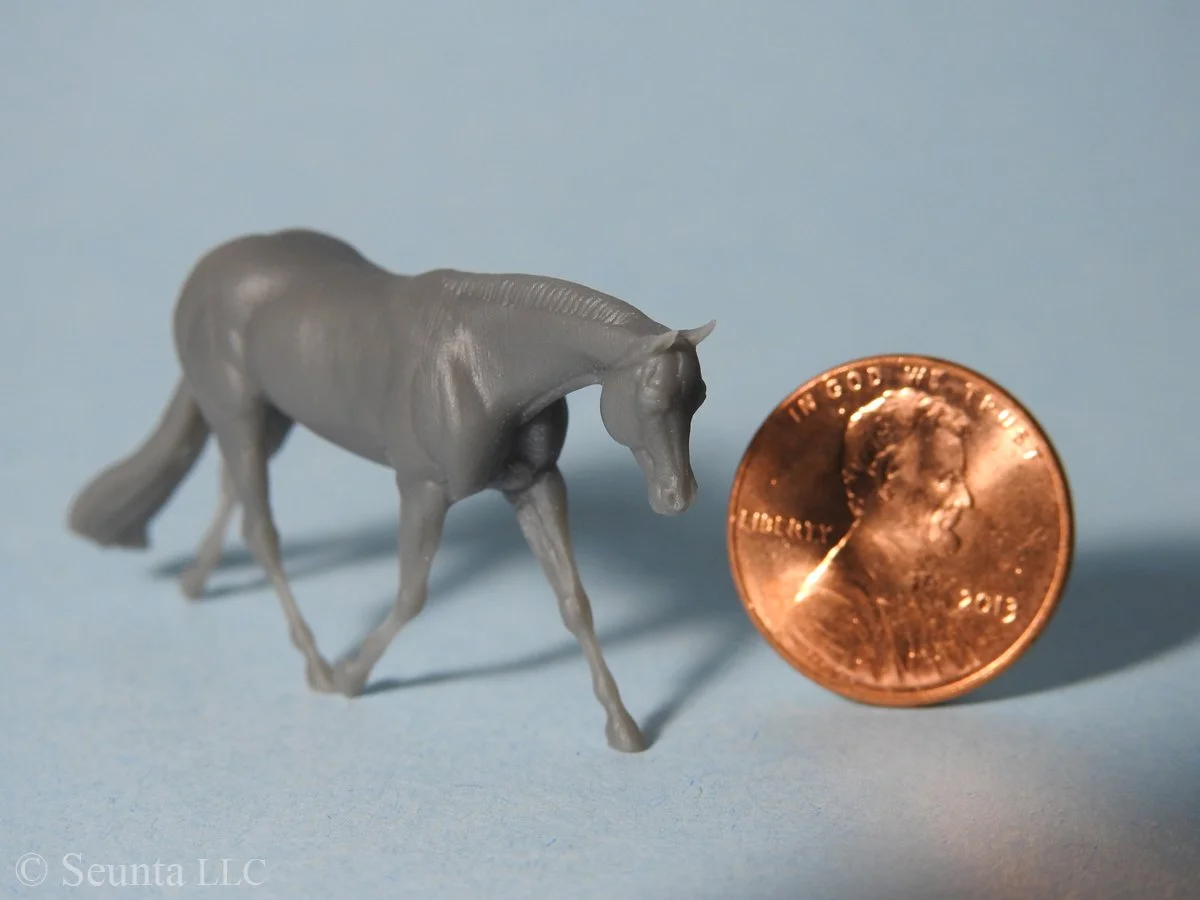
All Resin Horses Are Not the Same
In the model horse world, the word “resin” gets used broadly but not all resins are created equal. The material itself, and how it cures, makes a world of difference in strength, stability, and longevity.
Some resins are produced through 3D printing with UV-cured photopolymers, while others are created through traditional casting with polyurethane thermosets. Both can produce fine detail, but the science behind them is very different and that difference shows up in how they age over time.
1. 3D-Printed Resin (Photopolymers)
Proper name: UV-curable photopolymer resins.
Process: Used in SLA (stereolithography), DLP (digital light processing), and MSLA printers.
Chemistry: Made of acrylate or methacrylate monomers/oligomers mixed with a photoinitiator. When exposed to UV light or a laser, these molecules link together into a crosslinked solid plastic.
Key property: They harden instantly on exposure to UV but keep curing slowly afterward (post-curing). Because the polymer network is formed by free radicals in a light-driven process, the bonds are often imperfect and prone to brittleness, micro-cracking, and long-term instability.
2. Casting Resin (Polyurethane)
Proper name: Two-part polyurethane thermoset resin.
Process: Used for traditional mold-casting of resin models.
Chemistry: A polyol reacts with an isocyanate to form long urethane linkages, creating a dense, crosslinked thermoset polymer.
Key property: The reaction is chemical (not light-driven), resulting in a strong, stable polymer backbone. Properly mixed and cured, polyurethane castings are tough, slightly flexible, and highly resistant to environmental stress. They can last decades.
3D-printed resins are built in layers and cured by light, which leaves them with seams, trapped uncured material, and a tendency to grow brittle over time. Cast polyurethane, by contrast, cures chemically as one solid, continuous structure with no weak points. That is why cast resin horses remain stronger, tougher, and far more enduring than their 3D-printed counterparts.